How Grip Strength Connects to Everything from Injury Prevention to Cognitive Function.
For many athletes, "grip strength" is something only considered at the end of a heavy deadlift or during a pull-up test. It's often seen as a minor, functional link, where your grip is simply the tool that connects you to the weight. However, a growing body of scientific literature suggests grip strength is of greater importance.
Emerging research is repositioning grip strength from a simple measure of hand function to a powerful biomarker of overall health. It is proving to be a surprisingly accurate predictor of cardiovascular health, functional aging, and even cognitive function. For coaches and athletes, understanding this science opens new doors—not just for improving a personal best, but for building more resilient, healthier athletes, a key component of Injury Prevention.
This article explores the compelling and often surprising science of grip strength, well beyond its role in holding a barbell.
Grip: More Than a Single Metric
Before diving into the research, it's important to understand that "grip" is not a monolithic concept. Coaches should be aware of its primary components:
- Crush Grip: The power of your fingers and palm, e.g., squeezing a hand gripper or a firm handshake.
- Support Grip: The ability to hold onto an object for an extended time, e.g., a farmer's walk or a dead hang. This is about muscular endurance.
- Pinch Grip: The strength between your thumb and fingers, e.g., holding a weight plate by its edge.
A failure in any of these areas has implications. But it's the combined, measurable force—typically tested with a hand-held dynamometer—that has researchers' attention.
A Biomarker for Your Broader Health
The most compelling research on grip strength comes from large-scale epidemiological studies. Time and again, grip strength in mid-life proves to be one of the strongest predictors of future health.
A landmark 2015 study in The Lancet (Leong et al.), which followed nearly 140,000 adults, found that grip strength was a better predictor of all-cause and cardiovascular mortality than blood pressure. The findings were stark: each 5-kilogram (11-pound) decrease in grip strength was associated with a 16% increase in all-cause mortality and a 17% increase in cardiovascular mortality.
This was confirmed by a 2018 study using UK Biobank data (Celis-Morales et al.), which noted a ~20% higher risk of cardiovascular events for those in the weakest grip category compared to the strongest.
Why? Grip strength is a non-invasive, easy-to-measure proxy for overall muscle mass and sarcopenia (age-related muscle loss), a key concern for Master Athletes. Because it involves multiple muscle groups and a significant neural signal from the brain, it acts as a "snapshot" of the body's overall robustness and biological aging.
The Neural Link: Grip and Total Body Strength
Ask a powerlifter, and they will tell you: a strong grip feels like it makes your whole body stronger. This isn't just perception; it's neurology. The principle is known as neural irradiation or Concurrent Activation Potentiation (CAP).
When you grip an object with maximal force, the intense signal from your brain to your hand doesn't stay isolated. It "irradiates" or spills over to adjacent muscles, increasing neural drive up the kinetic chain. This signal effectively tells the central nervous system (CNS) that the body is stable and "safe" to produce maximum force.
For example, actively crushing the bar during a bench press increases the co-contraction of the rotator cuff, creating a more stable shoulder. Research on CAP has shown that a maximal clench with the non-lifting hand can increase force production in the lifting limb by 5-10% (Ebben, 2006). A strong, confident grip provides the neurological "permission" for the rest of your body to fire at full capacity.
The Grip-Injury Connection
Coaches often focus on the prime movers, but weakness in the hands and forearms can be a key driver of injuries further up the arm.
- Elbow Issues: Many cases of medial and lateral epicondylitis (Golfer's and Tennis Elbow) are not just issues of inflammation but are linked to weakness in the forearm extensors and flexors. Research on interventions for this condition (e.g., Bisset et al., 2005) frequently uses grip strength and endurance as key outcome measures, as muscle weakness is a primary component of the condition.
- Shoulder Stability: A weak grip creates a "break" in the kinetic chain. In pulling movements (like a pull-up or row), a failing grip causes the body to compensate. This often involves excessive elbow flexion (over-using the biceps) and shoulder elevation (over-using the upper traps), which can contribute to shoulder impingement and neck strain by preventing the lats and mid-back from doing their job.
The Surprising Link: Grip Strength and the Brain
Perhaps the most surprising research connects hand grip to cognitive function. Several longitudinal studies have shown that individuals with lower grip strength in their 40s and 50s have a higher risk of developing cognitive impairments decades later.
A 2018 study analyzing UK Biobank data (Firth et al.) found a strong, direct correlation between grip strength and cognitive functions like reaction time, visual memory, and reasoning. Even more striking, a 2023 study in JAMA Network Open (Park et al.) found that every 5-kg decrease in mid-life grip strength was associated with an 8% higher risk for incident dementia.
The proposed mechanism is that grip strength is not just a measure of muscle. It is a reliable proxy for the integrity of the entire neuromuscular system—a marker of overall system integrity. A decline in grip strength may be one of the earliest, most subtle physical signs of a systemic process—like chronic inflammation, poor vascular health, or neurodegeneration—that is also affecting the brain.
Practical Applications for Coaches
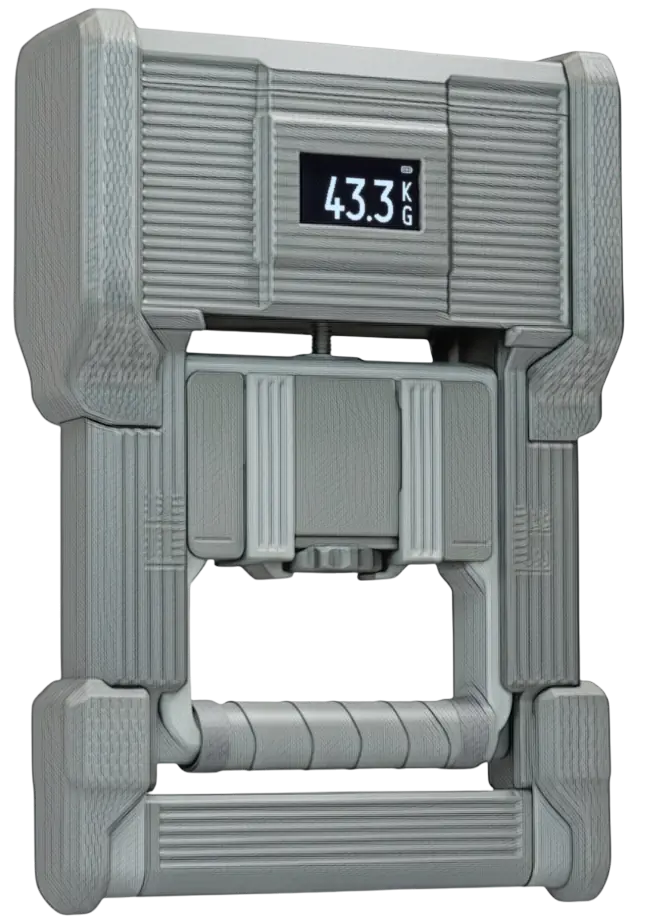
- Test It: Don't guess. Using an accurate hand grip dynamometer is an invaluable way to gather objective data and track progress. Test both hands.
- Train It (Holistically): Don't just rely on grippers. A complete program should include all three types of grip:
- Crush: Grippers, towel wring-outs, sand-bag carries.
- Support: Farmer's walks (with heavy dumbbells, kettlebells, or a trap bar), dead hangs (for time), towel pull-ups.
- Pinch: Plate pinches (holding two smooth plates together), hex dumbbell holds.
- Integrate It: Instead of just training grip at the end, use it to enhance other lifts. Cue athletes to "crush the bar" on their presses, "pull the bar apart" on their squats, and "grip aggressively" on their pull-ups. This uses the principle of irradiation to improve performance and stability instantly.
Summary
Grip strength is far more than the power in your hands. It is a window into the central nervous system, a key indicator of overall health, and a powerful predictor of future vitality. The handshake that begins a coaching relationship may be one of the most honest pieces of data an athlete can provide.
By understanding, testing, and training grip, coaches are not just building stronger hands—they are building stronger, more resilient, and healthier human beings.
References
- Leong, D.P., et al. (2015). Prognostic value of grip strength: findings from the Prospective Urban Rural Epidemiology (PURE) study. The Lancet, 386(9989), pp.266-273.
- Celis-Morales, C.A., et al. (2018). Associations of grip strength with cardiovascular, respiratory, and cancer outcomes and all cause mortality: prospective cohort study of half a million UK Biobank participants. The BMJ, 361: k1651.
- Firth, J., et al. (2018). Grip Strength Is Associated With Cognitive Performance in Schizophrenia and the General Population: A UK Biobank Study of 476 559 Participants. Schizophrenia Bulletin, 44(4), pp.728-736.
- Park, H., et al. (2023). Association of Grip Strength With Risk of Incident Dementia. JAMA Network Open, 6(3): e233375.
- Bisset, L., et al. (2005). A systematic review and meta-analysis of clinical trials on physical interventions for lateral epicondylalgia. British Journal of Sports Medicine, 39(7), pp.411-422.
- Ebben, W.P. (2006). A brief review of concurrent activation potentiation: Theoretical and practical constructs. Journal of Strength and Conditioning Research, 20(4), pp.985-991.