What's new in the world of grip dynamometers?
For decades, the hand grip dynamometer was a tool found almost exclusively in dusty clinical archives or the offices of hand therapists. It was a medical device used to diagnose sarcopenia in the elderly or track recovery after carpal tunnel surgery.
But the narrative has changed. As we discussed in our previous article on The Surprising Science of Grip Strength, grip strength is now recognized as a "vital sign"—a powerful biomarker for central nervous system (CNS) readiness, overall mortality, and athletic performance.
This shift in understanding has driven a shift in technology. We are moving away from the heavy, analog hydraulic gauges of the past toward smart, data-driven tools that integrate seamlessly into modern training and rehabilitation.
This guide explores the evolution of grip testing equipment, the science of why you should be using one, and what to look for when choosing a dynamometer.
The Evolution of the Dynamometer
To understand the current landscape of equipment, it helps to look at where we started. Grip dynamometers generally fall into three categories:
1. Hydraulic (The Old Standard)
For nearly 50 years, the hydraulic dynamometer (often referred to as the Jamar style) was the gold standard in clinical research.
- How it works: A sealed hydraulic system measures the pressure applied to a fluid-filled chamber.
- Pros: Durable and widely cited in older academic literature.
- Cons: Heavy (often ~1.5 lbs+), prone to hydraulic leaks over time, and difficult to read precisely. The analog dial requires you to "eyeball" the result, often leading to measurement errors, and data must be manually recorded.
2. Basic Digital (The Consumer Tier)
With the rise of cheap electronics, the market flooded with basic digital grippers.
- Pros: Inexpensive and easier to read than a dial.
- Cons: Often utilize low-quality strain gauges with poor accuracy (variances of ±2-3kg are common). They rarely store data, meaning they are useful for a "fun challenge" but unreliable for clinical or athletic tracking.
3. Smart Dynamometers (The Modern Standard)
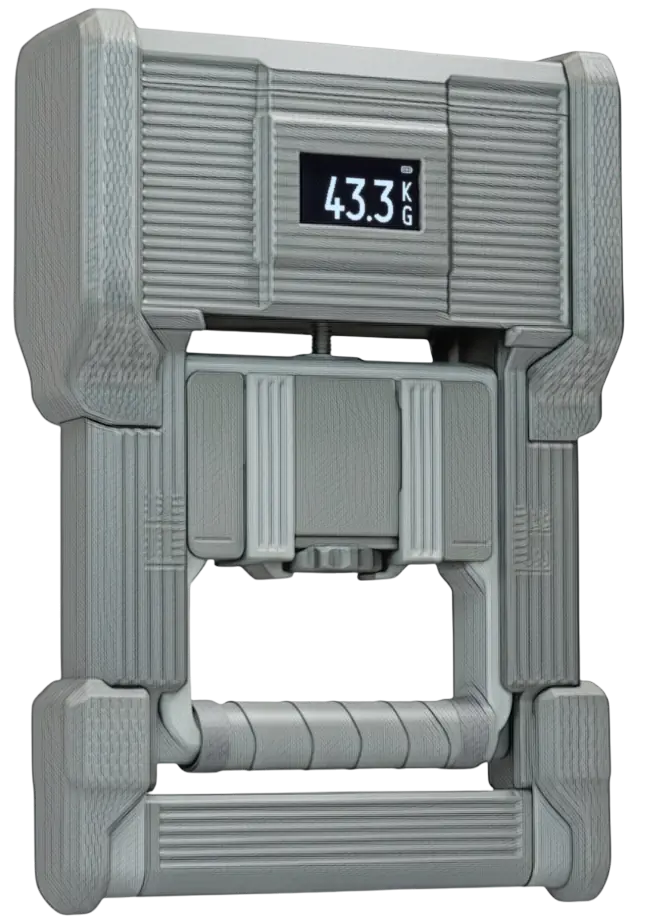
This is where the DEXDIA GX fits in.
- How it works: High-precision load cells connect via Bluetooth to mobile applications.
- The Advantage: The magic isn't just in measuring the force; it's in capturing the data. Smart dynamometers allow for longitudinal tracking, automatic calculation of asymmetry, and visualization of force curves (peak force vs. time to peak).
Why You Need a Dynamometer: The Science of Application
Whether you are a clinician or a strength coach, the utility of a dynamometer goes far beyond seeing "how strong" a hand is.
1. For Fitness & Performance: The "CNS Check Engine Light"
One of the most powerful applications of a dynamometer in sports science is Autoregulation.
Your grip strength is uniquely taxed by the central nervous system. Unlike large muscle groups that may feel sore from local tissue damage, your grip strength is a reliable proxy for neural drive. Research suggests that a significant drop in grip strength (often >5-10% below baseline) correlates with systemic CNS fatigue.
- The Protocol: Measure your grip every morning.
- The Insight: If your grip is down significantly, your nervous system has not recovered, even if your muscles feel fine. This is your signal to lower the volume or intensity of your training session.
2. For Rehabilitation: Objective Benchmarking
"It feels better" is not a metric. In rehabilitation—whether for tennis elbow (lateral epicondylitis), rotator cuff repair, or wrist fractures—objective data is King.
A dynamometer allows for Asymmetry Analysis. The general clinical rule of thumb is the 10% Rule: In healthy individuals, the dominant hand is typically ~10% stronger than the non-dominant hand. Deviations from this norm can highlight deficits that are invisible to the naked eye.
The Gold Standard Protocol (ASHT)
Having the best equipment is useless if the testing methodology is flawed. To ensure your data is valid, you should follow the protocol set by the American Society of Hand Therapists (ASHT).
The Setup:
- Position: Seated upright with feet flat on the floor.
- Shoulder: Adducted (resting by your side) and neutrally rotated.
- Elbow: Flexed at exactly 90 degrees.
- Wrist: Neutral position (0 to 30 degrees extension).
- The Squeeze: Three trials per hand, alternating between left and right to allow for recovery (approx. 15-30 seconds rest). Take the average of the three trials.
Note: Testing with the arm fully extended (common in powerlifting circles) uses different leverage and will produce different numbers. Consistency is key.
Spotlight: The DEXDIA GX Advantage
We designed the DEXDIA GX to bridge the gap between clinical accuracy and modern convenience.
While hydraulic devices remain in hospitals due to legacy, the DEXDIA GX offers features that modern practitioners actually need:
- Precision: High-fidelity load cells capable of measuring from 0 to 100kg (220lbs) with ~±1% accuracy.
- Wireless Ecology: The device syncs instantly with the GripMeter app. This eliminates the "write it down and lose the paper" problem.
- For Individuals: Track your CNS readiness daily.
- For Coaches: Use the GripMeter Physio app to manage profiles for multiple clients, exporting PDF reports to show progress over time.
- Robust Build: Designed for the gym bag, featuring TPU bumpers for durability and an ergonomic handle wrapped for high-force comfort.
Summary
A grip dynamometer is no longer just a tool for checking if an injury has healed. It is a daily diagnostic device for the nervous system and a critical tracker for longevity.
By choosing a smart device like the DEXDIA GX and adhering to proper ASHT testing protocols, you unlock a layer of data that takes the guesswork out of training and recovery.